
He Would Have Sued the Bottle
How the myth of Captain Morgan may hit a bit too close to home.
A Rum-soaked Swashbuckler Died the Way He Lived
Picture a pirate like Billy Bones. A cutlass covered in dried blood, a chest overflowing with golden loot, and the weathered salty sea dog lying in bed, bloated with dropsy, years of hard living finally catching up with him. His doctor implores him to stop drinking, because rum is killing him before his eyes. Billy ignores him, of course, because the Captain doesn’t take orders. Between Treasure Island and every other pirate story ever written, this is the ending we expect. Why should the legend of Captain Morgan be any different?
From a young age, Morgan called Jamaica home. The great Welsh privateer spent decades looting and plundering the Spanish Empire before settling down. He acquired land in Clarendon, in an area that came to be known as Morgan’s Valley. In 1681, as deputy governor of the colony, he pardoned an old associate named Moses Cohen Henriques, a Sephardic Jewish privateer who resorted to piracy. Henriques then settled down in Jamaica, where he would become a successful sugar plantation owner. Generations later, the Henriques brothers, still involved in the family business of sugar, purchased New Yarmouth Estate. Just a few decades later, that distillery would become the very place where Captain Morgan rum is made.
And then there is the death. By 1688, his own physician, Hans Sloane, the very man whose personal collection would go on to found the British Museum, was telling him to stop drinking.1 Morgan deliberately disobeyed his doctor, and soon after, he died with a swollen belly and yellowed eyes. He was a pirate who placed rum above all else.2
It’s the perfect story about Captain Morgan. It could potentially even be the true story. But it is also the kind of story the real Captain Morgan would have taken you to court over.
The Lawsuit
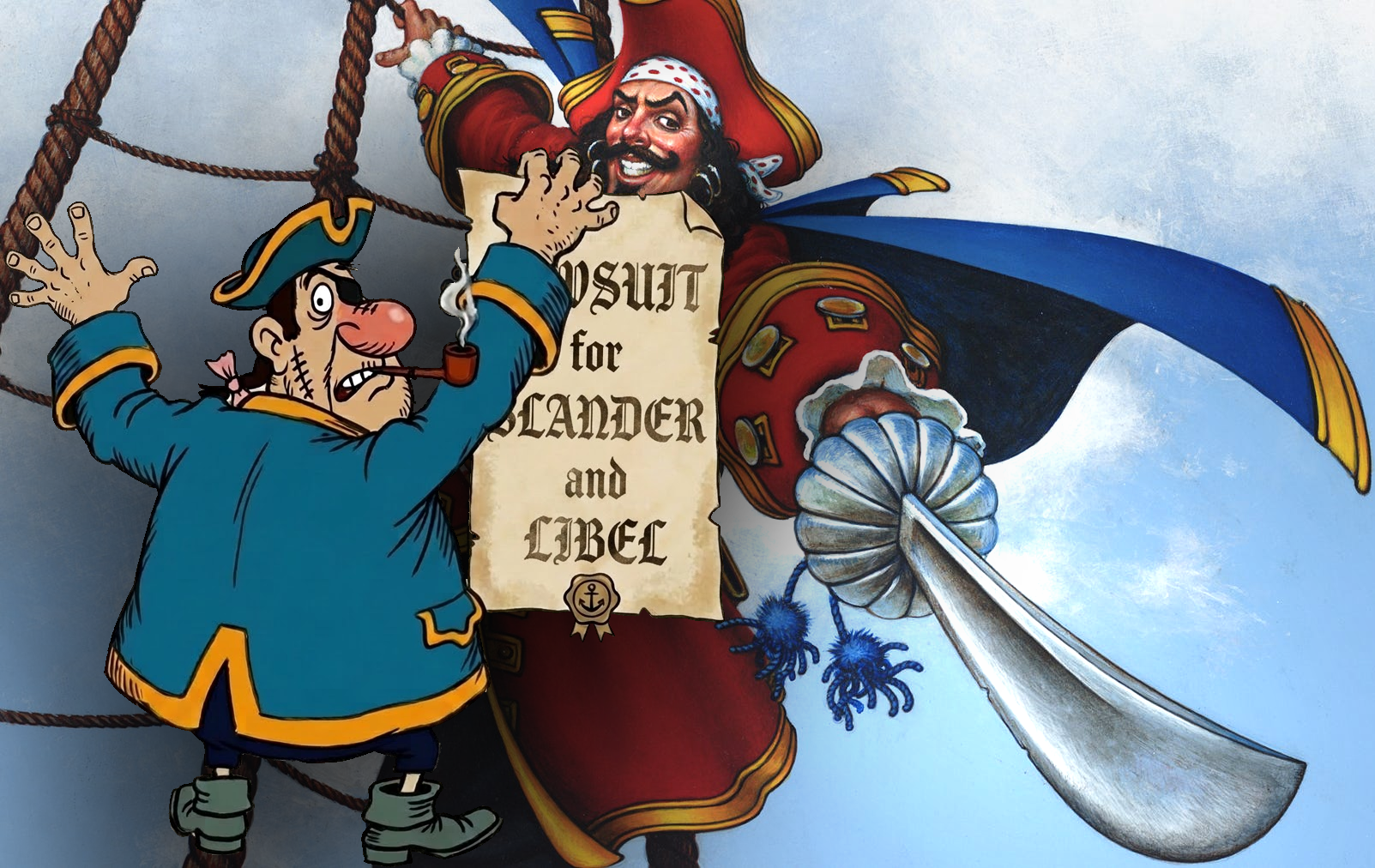
Alexandre Exquemelin’s The Buccaneers of America portrayed Morgan as a pirate of spectacular violence. Exquemelin himself was a surgeon who had sailed directly under Morgan’s command. When the English edition was published in London, Morgan sued, not just over the word “pirate”, but also over a deeply personal origin story. Exquemelin claimed young Harri Morgan (his name wouldn’t be anglicized to Henry until later in life) had been kidnapped off the streets and shipped to the Caribbean as an indentured servant.34 Morgan won his libel case, received £200 in damages, and forced the publishers to retract some claims about him.56 In his affidavit, he went to considerable lengths to establish his hatred of piracy and his status as a respectable gentleman.6 Perhaps Exquemelin held a grudge against Morgan and used his book as an opportunity to tarnish his reputation unfairly. Or, perhaps he knew the true Morgan, and the buccaneer used his political connections to silence him.
The Buccaneer’s Ledger
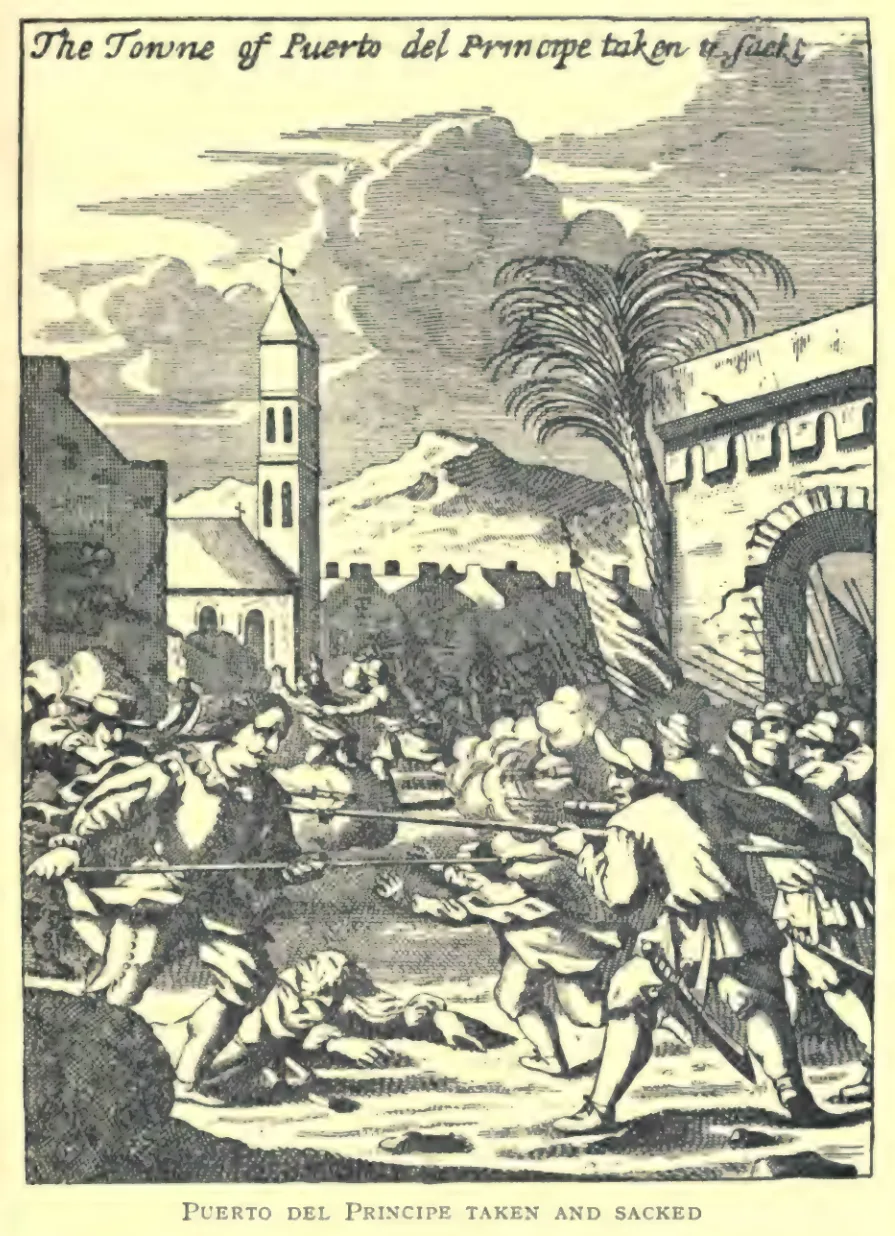
Henry Morgan leading the sacking of Puerto del Principe.
Exquemelin, The Buccaneers of America
But long before Morgan was fighting to control his reputation in court, his indestructibility became the stuff of legend. In January 1669, Morgan’s flagship, the Oxford, was anchored off Île-à-Vache (Isla Vaca) celebrating a recent capture. During a wild, drunken deck party, with cannon fire lighting up the night like fireworks, a stray spark hit the powder magazine.7 The ship went up in a catastrophic blast, leaving hundreds of Englishmen and an unknown number of French prisoners dead, and only a handful of survivors.89 Morgan was among them, reportedly thrown through the window of his cabin and into the sea by the blast.10 He climbed out of the water, regrouped, allegedly looted the bodies for clothes and jewelery,8 and kept sailing.
The distinction between privateer and pirate can get slippery in the seventeenth-century Caribbean. He operated under English letters of marque, yet his men signed articles of agreement that included a grim injury payout scale, such as six hundred pieces of eight or six enslaved people for a right arm. Accounts of his campaigns described torturing civilians to reveal where the treasures are hidden, and Catholic nuns being forced to carry ladders toward Spanish defenses as human shields.8 After the 1671 Panama raid, when the haul proved disappointing and his men accused him of undervaluing the loot, Morgan loaded the better part of the booty onto his own ship and slipped away for Port Royal in the night, leaving members of his own crew stranded.411 This event would mark the end of Morgan’s career as a privateer, as the Panama raid occurred after the peace treaty had been signed, and Spain demanded blood, declaring that this technically made Morgan’s actions acts of piracy. England arrested Morgan and shipped him back to London aboard a vessel named, ironically, HMS Welcome, along with Jamaican governor Thomas Modyford, who had authorized the raid.53 However, Morgan essentially spent his London arrest networking and being hailed as a hero,12 and two years later, Charles II knighted him and sent him back to Jamaica as deputy governor.11
The Fragile Illusion
Yet, the fight to be seen as the respectable gentleman was an uphill battle. His frequent drunken parties and foul mouth drew the ire of some Jamaican politicians.13 Upon his return to Jamaica as deputy governor, Morgan was ordered to eradicate piracy, and explicitly could not issue letters of marque. Instead, he directed captains to the French island of Tortuga, where the governor still issued letters of marque against Spanish ships, and in return, the French governor sent Morgan kick-backs for the referrals.14 The privateers returning to Jamaica to offload stolen loot caused the scheme to be revealed, and hearings were held to investigate whether Morgan was collaborating with the French. In 1683, ten years into his political career, Morgan was purged from the Jamaican government for corruption and misconduct after the governor charged him with “disorder, passions, and miscarriages” and “countenancing men in disloyalty”.13 In his increasingly typical drunken state, he ranted and cursed the Assembly, which, in a surprise to no one but Morgan, convinced the Assembly that he was no longer capable of governing effectively.13 Morgan was stripped of all his commands and offices, and he spent his final years as a disgraced political has-been on his plantation, only regaining his power five years later in 1688 through sheer cronyism when a personal friend took over as governor, though the redemption was short-lived, as he was too ill to perform any duties.15 His alcohol consumption caught up to him, and Morgan died that same year.
He purchased three sugar plantations and, at the time of his death, held title to 131 enslaved people. Though he died wealthy in land and slaves, he was in debt and had no money left.16 He was a deeply compromised colonial administrator, having spent his twilight years and fortune making sure that the public record reflected his legitimacy. Captain Morgan rum took Henry Morgan’s desperate grasp for respectability and made it walk the plank, building the brand’s entire identity on the exact legend he paid lawyers to erase.
The About-Face
There is another problem with putting Henry Morgan on a bottle: which Henry Morgan are we looking at?
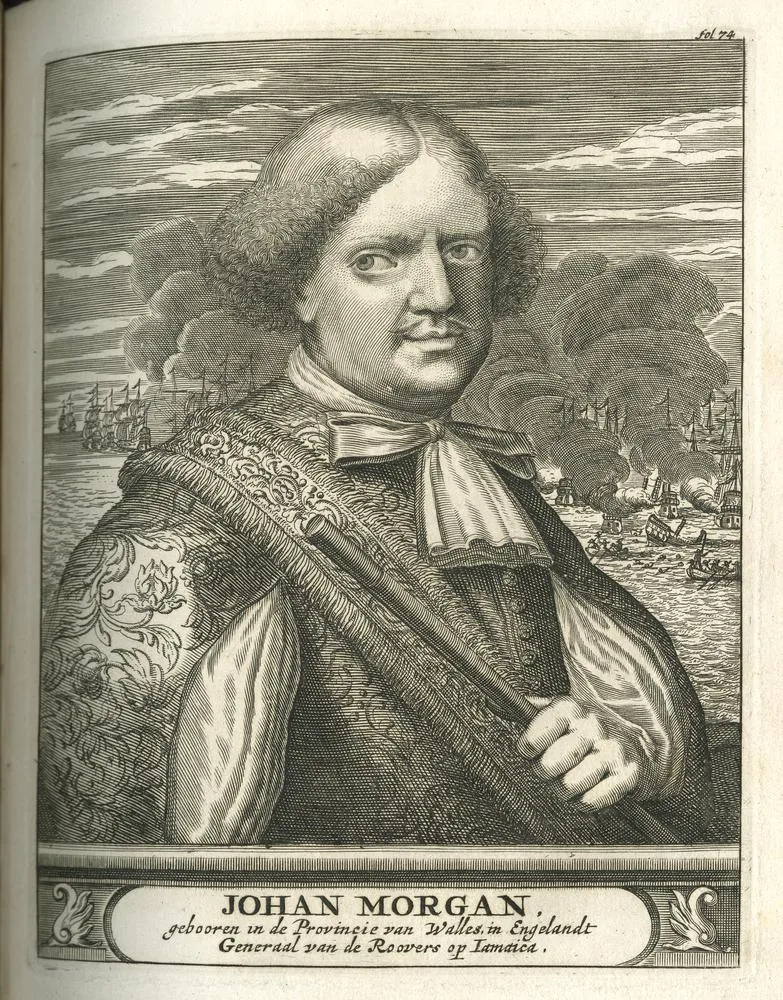
Five years into Morgan’s political career, Alexandre Exquemelin published his infamous book with an engraving by Herman Padtbrugge. The book claims these portraits were drawn “from life,” and while we cannot prove Padtbrugge ever saw Morgan in person, the British Museum catalogs it unambiguously as Sir Henry Morgan. In the engraving Morgan is shown at half-length, with curly hair, moustache, sash across his chest, and holding a commander’s baton. He is dressed like a respectable naval commander, but behind him, a convoy of ships is ablaze, as they burn and sink in the harbor. The image is captioned “Generaal van de Roovers op Jamaica” (“General of the Robbers from Jamaica”).
When Exquemelin’s book was translated into English, it gave him a makeover. Frederick Hendrik van Hove based his portrait on Padtbrugge’s earlier engraving, but stripped away the burning ships and the baton and placed Morgan inside an ornate oval frame, on top of softening the harsh descriptions of his life. The pirate was already being transformed into a gentleman.17 You might think all these adjustments during the translation to English would have satisfied him. But remember, even this wasn’t good enough, and he still sued the publishers, demanding that they make him look even less objectionable.
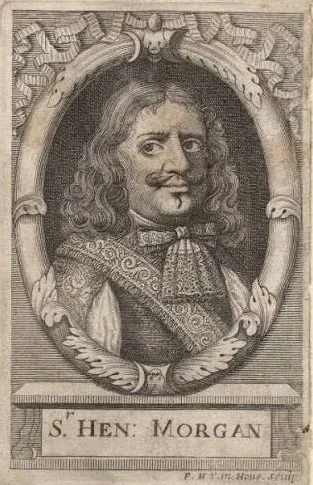
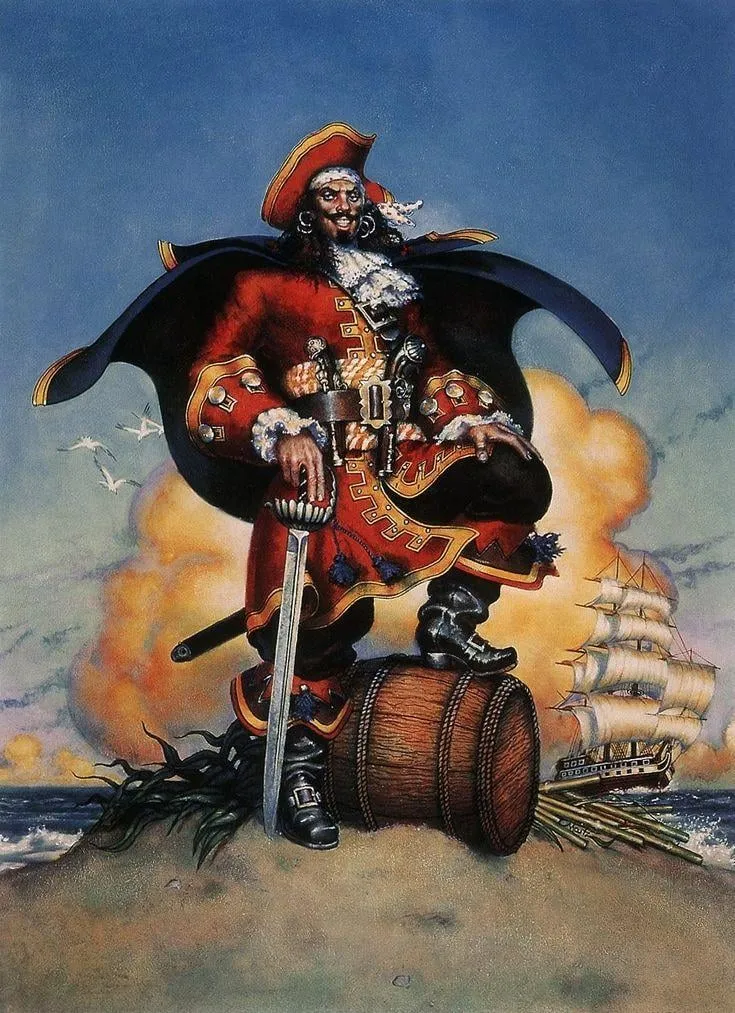
So there really is a complicated history behind the portraiture of Sir Henry Morgan. However, the grinning, big-hatted figure with one boot on a rum barrel didn’t come from any of that anyway. He was invented from scratch in the early 1980s by Don Maitz, a fantasy illustrator with a career built on painting pirates, commissioned to design a “happy scoundrel” for the American market.18 The real Morgan was a sour-faced gentleman, while the mascot needed to look like someone who convinces you to buy another round.
That schism survived even into the brand’s legal battles over its imagery. Alcohol Concern complained to Britain’s Portman Group that Captain Morgan’s packaging used cartoon-like pirate imagery that might particularly appeal to under-18s. The complaint was dismissed on the grounds that the character is based on a real historical figure,19 which is ironic, considering Morgan had spent his later life insisting that he was a respectable gentleman rather than a pirate.
The Rum from Jamaica
At this point, you might think that Captain Morgan is simply a modern brand dressing up a random rum in pirate costume. As far as budget rum goes, that would be completely par for the course, unfortunately. But actually, there are surprising connections that Captain Morgan rum has with Jamaica.
Seagram introduced the brand in 1944, and Jamaica, the island where Morgan spent his entire adult life, became part of the rum’s production story. By most accounts, the famous spiced rum recipe traces not to a pirate’s private stock, but to Levy Brothers, a Kingston pharmacy that had been infusing rough Jamaican rum with medicinal herbs and spices and selling it as a tonic.19 Samuel Bronfman liked what he tasted and bought the rights, but “Levy Brothers Pharmacy Spiced Rum” didn’t quite have a nice ring to it, so a privateer with a recognizable reputation in the country was a better bet. A few years later, Seagram bought the Long Pond distillery to lock in a steady supply for Captain Morgan rum.19 Then in 1960, the whole conglomerate split. A corporate reshuffling left J. Wray & Nephew holding the exclusive rights to make and sell Captain Morgan inside Jamaica, using rum drawn from New Yarmouth.20 Everywhere else in the world, the rights eventually landed with Diageo.21
How similar was the rum that Henry Morgan drank to the Captain Morgan rum we have in stores? Barely recognizable. Seventeenth-century Caribbean rum, called “kill-devil”, was raw, unaged, and by contemporary accounts close to undrinkable straight. Sailors and privateers cut it with sugar, citrus, water, and spice into a rough swill called bumbo, not because anyone was chasing the spiced rum flavor, but because the alternative was repulsive. So Morgan’s world really did have people doctoring rough Caribbean rum with sugar and spice, but the modern column-still, vanilla-forward product descended from a Kingston pharmacy, not from a barrel of bumbo on Morgan’s own ship.
The Echo
Back in his seafaring days, Morgan was acquainted with Moses Cohen Henriques.22 Though Henriques had once sailed under the Dutch flag as a privateer, he later crossed the line into outright piracy… an act Morgan, ever the stickler for legal legitimacy, would officially pardon in 1681.22 The man who went to court to prove he was never a pirate used his power to officially forgive a man who actually was one.
Later, the Henriques family was involved in Jamaican commerce and sugar, and Henriques Bros Ltd. eventually came to possess New Yarmouth.21 That raises one irresistible question: were those Henriques brothers actually descended from the man Morgan pardoned in 1681?
If they were, the story forms a hilarious circle. Morgan pardons Henriques, Henriques becomes a Jamaican sugar magnate, his descendants enter the rum business, and New Yarmouth becomes part of the Jamaican Captain Morgan story. It would be an extraordinary piece of continuity, but no documented bloodline connecting the 17th-century Moses Cohen Henriques to the 20th-century Henriques family who owned New Yarmouth has surfaced. However, the connection is completely conceivable, and at the very least, it’s one hell of a coincidence, even if it can’t be proven.
The Wrong Ship
If you’re looking for stronger connections between the man and the rum, so was Diageo. Beginning around 2010, the Captain Morgan brand helped fund a multi-year underwater archaeology project, led by Texas State University, searching for the fleet Morgan lost off Panama during his 1671 career-ending raid. In 2011, the team announced that they had found the wreck believed to be Morgan’s flagship, the Satisfaction. In promotional material for the project, brand director Tom Herbst offered a confident assessment about the discovery: “In our case, we don’t have to make up a brand story – ours is real and it’s waiting to be discovered at the bottom of the ocean floor.”23
Well… not quite. Further analysis eventually identified the wreck not as Morgan’s flagship Satisfaction, but as the Nuestra Señora de la Encarnación, a Spanish merchant ship that sank a full decade after Morgan’s raid.24 The wrong ship, the wrong decade, and the wrong side of the war. The Captain Morgan team had gone looking for the real-life inspiration for its brand and wound up excavating one of the Spanish ships belonging to the people Morgan had spent his career attacking.
So, they opted for plan B: a 2014 limited-edition bottle, “Captain Morgan 1671”, named for the year of the raid. It was finished in Spanish oak, chosen because barrels of that sort were believed to have been on Morgan’s ship.25
A Legend In A Bottle
We started with a pirate drinking himself to death, a pardoned comrade whose descendants supposedly kept his rum alive, a Jamaican valley bearing his name, and a bottle that capitalizes on his legacy. True, most of that story turned out to contain a gap somewhere, but that is exactly what makes the legend of Captain Morgan so interesting.
The real Morgan spent his last years and a fortune making sure the official record called him anything but a pirate. He won the lawsuit, but he lost the war. Three hundred years later, a liquor company put him back in the costume anyway, and gave him a grin he never had in his life.
Sir Henry Morgan spent his final years trying to bury his own legend.
Captain Morgan bottled it.
Footnotes
-
Dr. Sloane never actually names Henry Morgan. His patient is identified only as “Sir H.M.”, widely attributed to Morgan. A 1988 paper in Medical History argued that the patient could potentially have been another Jamaican official. ↩
-
Under the Black Flag: The Romance and Reality of Life Among the Pirates ↩
-
Sources vary whether around 250 or 350 people died in the explosion, and whether the number of survivors was 10 or 30. ↩
-
David Hepper, British Warships in the Age of Sail 1640-1860 (Seaforth Publishing, 2023) ↩
-
The Buccaneer King: The Biography of the Notorious Sir Henry Morgan 1635–1688 ↩
-
The Buccaneer King: The Biography of the Notorious Sir Henry Morgan 1635–1688 ↩
-
The Buccaneer King: The Biography of the Notorious Sir Henry Morgan 1635–1688 ↩
-
The Liminal, The Licentious, and the Illicit: Pirate Portraits in Alexandre-Olivier Exquemelin’s De Americaense Zee-Rovers ↩
-
J. Wray & Nephew has two distilleries: Appleton Estate and New Yarmouth. Appleton Estate is more focused on premium rums, while New Yarmouth is more focused on bulk rum production, therefore it is most likely the source of the rum used in Captain Morgan. ↩
-
Underwater Archaeologists Dig Deep For Iconic Privateer Captain Henry Morgan’s Lost Fleet In The Caribbean ↩
-
Descubren un navío español hundido en 1681 en el Caribe de Panamá ↩